3.1 In-class activity
The EGP scheme (Erikson, et. al, 1979) is one of the most widely used, both in international and regional terms, for the study of class structure and social mobility. It was John Goldthorpe who was responsible for popularizing it through his research, becoming used, from an adaptation, by the European Statistical Office as the official classification (European Socio-economic Classification) 1].
According to the author, the scheme should not be considered as a definitive map of the class structure, but as a working tool that can undergo changes and modifications. In its construction, both theoretical ideas and practical considerations were involved, depending on the context in which it originated, the purposes and the nature of the information on which it was to be applied (Erikson, 1992: 32).
In reference to the operational criteria involved in the construction of the scheme, the following are considered (Mendez & Gayo, 2007: 146):
the ownership of the means of production,
the existence and number of employees (for those who are not wage earners),
the non-manual - manual - agricultural distinction, and
the type of employment relationship (service or contractual relationship).
The following scheme details the main classification criteria and the assignment of classes.
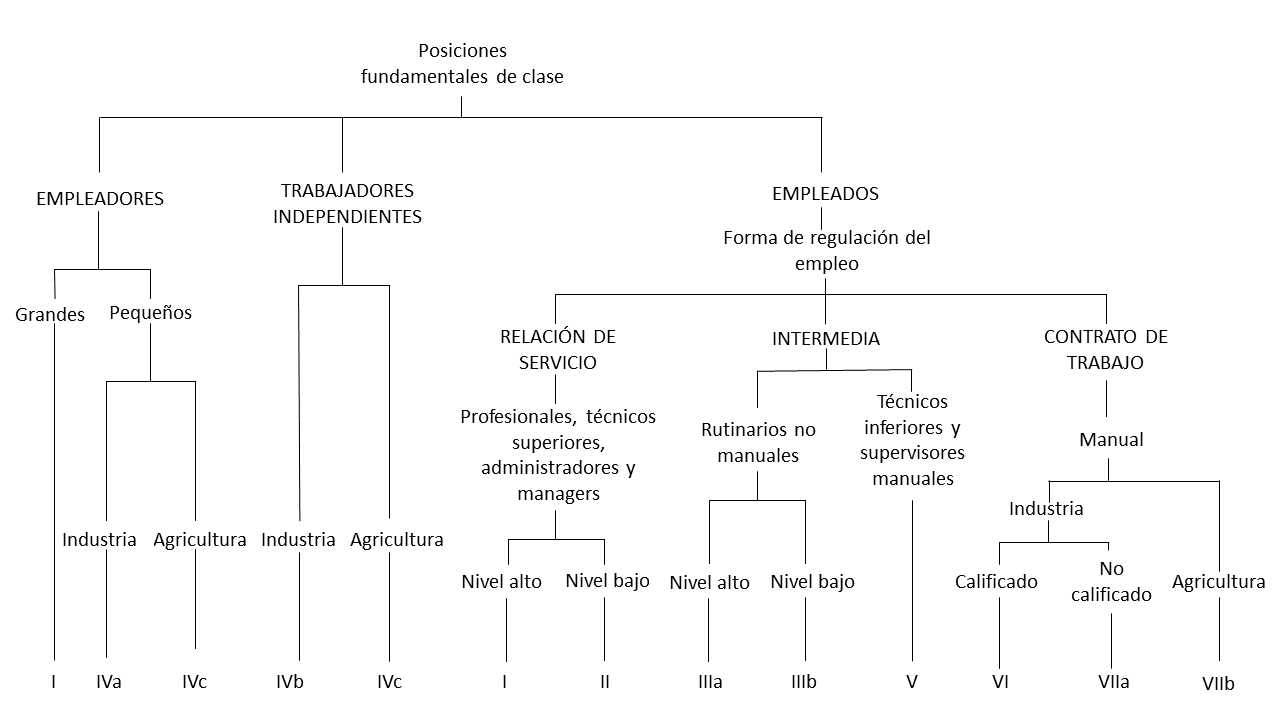
Gráfico 3.1: Derivación del esquema de clases EGP. Fuente: Erikson y Goldthorpe (1992)
Thus, the first major division occurs at the level of production relations, differentiating between employers (employers), self-employed workers (self-employed workers) and employees (employees). In the case of employers, a further distinction is made according to whether they are large or small companies, as well as by their branch of activity (industry or agriculture), as in the case of self-employed workers. The operationalization becomes more complicated when disaggregating the salaried world. This is where the criterion of the type of employment relationships comes into play.
The service relationship gives rise to what the author calls the “service class”, which is made up of professional employees, administrators and managers. Contracts are usually long-term and the mode of employer-employee exchange is usually diffuse, in the sense that not only the salary acts as a form of payment, but also certain prospective elements (raises, social security, pensions, etc.) that guarantee the stability and sustainability of employment. The “service” employee obtains autonomy and discretion, his performance depending on the “moral agreement” with the employer and not on external sanctions. In contrast, the relationship based on the contract of employment, refers to what in aggregate terms can be understood as the “working class”. Unlike the service relationship, contracts are usually for a shorter term and an exchange of money for effort is made, calculated on the basis of hours worked. Discretion and autonomy tend to be low, as worker performance is tied to increased supervision and external conditioning in the form of sanctions. In between these two ideal types of relationships are the mixed forms that give rise to the intermediate classes.
On the other hand, the classes (identified in the previous chart by Roman numerals) can be classified in different ways, depending on how disaggregated the information is to be presented. At the most disaggregated level, the scheme has 11 classes; however, the authors have worked with collapsed 7, 5 and 3 classes.
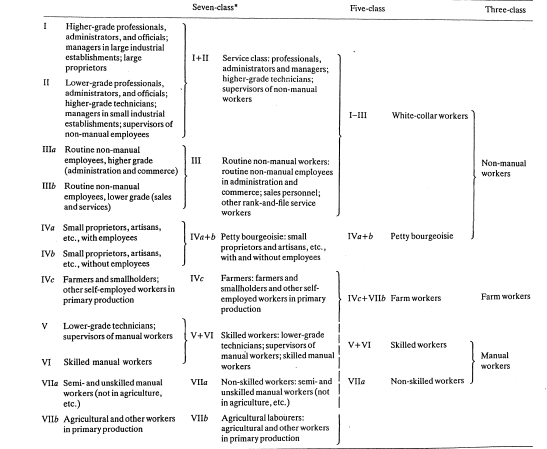
Gráfico 3.2: Esquema de clases EGP. Fuente: Erikson y Goldthorpe (1992)
Although there is literature (Erikson, 1992; Rose & Harrison, 2007) that provides some hints on how to operationalize the EGP scheme, there is no direct and univocal way to do so. Goldthorpe and Heath (Goldthorpe & Heath, 1992] have carried out the exercise of operationalizing it, but for use with the English standardized classification of occupations, which differs from both ISCO-88 and ISCO-08. Below we show a page of this work where we can see, in the first column, the occupational classification used, while the following columns show the other variables used: manual/non-manual nature of the occupation and occupational category (employment status). Each cell represents a possible class position, derived from the combination of categories. The numbers indicate to which class each combination points.
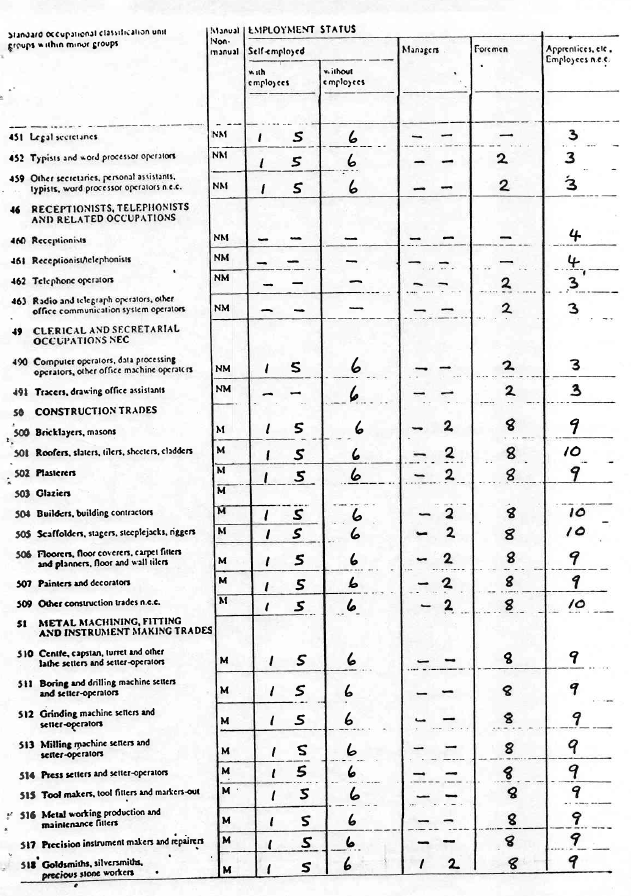
Gráfico 3.3: Tabla de operacionalización del esquema EGP original. Fuente: Goldthorpe y Heath (1992)
Source:
Sacco, N., Rodríguez de la Fuente, J. & Jaime, S. (forthcoming) Cookbook for the Analysis of Social Classes. ENDESA.